

For much of my career, I’ve worked in the field of trauma. I’ve spent more than two decades helping organizations understand the impact of abuse, neglect, violence, loss, and adversity on the people they serve. I’ve worked alongside child welfare agencies, children’s advocacy centers, healthcare systems, educators, and community organizations seeking to better understand how difficult experiences shape the people they support. I helped implement trauma-informed care before it became a widely recognized term and spent years translating trauma science into practical strategies that frontline professionals could use in their daily work.
At the time, trauma-informed care represented a profound shift in thinking. Rather than asking, What’s wrong with you?, we began asking, What happened to you? Rather than viewing behavior as simply a matter of choice, we started recognizing the ways that adversity shapes development, relationships, beliefs, and expectations about the world.
The shift mattered.
For generations, people who experienced abuse, violence, neglect, and other forms of adversity were often misunderstood. Children were labeled defiant rather than frightened. Adults were viewed as difficult rather than struggling. Systems were designed around compliance rather than healing. Trauma-informed care offered an alternative perspective, one that recognized that people make sense when we understand the context of their lives.
I was fortunate to be part of that movement early in its development. Like many of my colleagues, I believed deeply in its promise. If we could help organizations understand trauma and create environments characterized by safety, trust, collaboration, and empowerment, perhaps we could improve not only individual outcomes but entire systems.
In many ways, we did.
Over the past twenty years, trauma has moved from the margins of professional discourse into the mainstream. Books such as The Body Keeps the Score introduced millions of readers to the relationship between trauma, the brain, and the body. The Adverse Childhood Experiences study helped illuminate the long-term impact of adversity on health and well-being. Social media amplified conversations about triggers, attachment, nervous system regulation, and healing.
Today, it is difficult to spend much time online without encountering trauma language.
In many ways, that increased awareness has been incredibly valuable. We have become far more compassionate and informed about the ways difficult experiences shape human behavior. We are more likely to recognize the impact of adversity and less likely to dismiss suffering with phrases like “just get over it.”
But over time, I’ve also noticed something else. As trauma language has become more common, it has also become more diffuse. Increasingly, I hear the word trauma used to describe almost any distressing experience. Stress and trauma are often used interchangeably. Difficult conversations become traumatic. Disagreements become traumatic. Policies become traumatic. Leadership decisions become traumatic.
While I am grateful that people are talking about trauma more openly than ever before, I sometimes worry that the word is losing some of its precision, and with it, some of its usefulness. The more I reflected on this tension, the more I found myself asking a different question.
Not simply:
What happened to you?
But:
How did you adapt to your life experiences?
That question has increasingly become the foundation of my work.
In his book The Myth of Normal, Gabor Maté discusses the distinction between what many people call “Capital-T” trauma and “small-t” trauma. While he was not the first person to make this distinction, I found his overview helpful.
“Capital-T” trauma refers to experiences that clearly overwhelm a person’s ability to cope. These are events such as abuse, violence, serious accidents, natural disasters, war, or other significant threats. They overwhelm the nervous system’s ability to process what is happening in the moment and can leave lasting psychological, emotional, and physiological effects. Often, these experiences can be traced back to a specific event, or cluster of events, that profoundly altered the trajectory of a person’s life.
Although these experiences are often associated with extreme circumstances, they are far more common than many people realize. Research suggests that approximately 70% of individuals worldwide will experience at least one potentially traumatic event during their lifetime (Kessler et al., 2017). Most people will eventually recover without developing long-term trauma symptoms. However, for some, the impact persists and may result in conditions such as posttraumatic stress disorder (PTSD), characterized by symptoms such as re-experiencing, avoidance, hypervigilance, and changes in mood or thinking.
For many of my colleagues working in human services, healthcare, education, and emergency response, these are the experiences we encounter every day. They are often the reason people seek support in the first place and have shaped much of what we know about trauma, healing, and recovery.
“Small-t” trauma is different. These experiences may not meet a clinical definition of trauma, yet they still leave a lasting imprint. They are often experiences that require us to adapt to maintain a sense of safety, connection, predictability, or control.
Many would argue that most, if not all, of us have experienced events like these throughout our lives. They are often woven into the ordinary fabric of human relationships: moments of exclusion, criticism, disappointment, loss, misattunement, or disconnection. While these experiences may not overwhelm our capacity to cope in the same way as “Capital-T” trauma, they can still shape how we see ourselves, what we expect from others, and the strategies we develop to navigate the world.
In that sense, the defining feature is not the event itself, but the adaptation that follows.
Being bullied at school for not being like the other kids.
Moving repeatedly, losing social connections and a sense of safety in one location.
Growing up with a parent who loved you deeply but was emotionally unavailable.
Being raised in a blended family and feeling like you never quite belonged in one place or another.
Living with constant criticism that slowly becomes internalized as the belief that you are not enough.
None of these experiences would necessarily warrant a child abuse report. They may never become the focus of a trauma-focused mental health treatment plan. Yet they can profoundly shape our inner scripts—the stories we tell ourselves about who we are, how we relate to and trust others, and what we expect from the world around us.
These experiences are often relational in nature, emerging within our families, peer groups, schools, and communities. They shape our beliefs about belonging, safety, trust, and worthiness. They influence which parts of ourselves we reveal to others and which parts we learn to conceal to maintain connection, acceptance, or protection.
I remember being eight years old and auditioning for my school’s talent show with a dance routine. I’d never taken a dance class and was woefully unprepared. I just wanted to have fun, and I didn’t know what I didn’t know about dance choreography and performance. The judges were kind enough to not accept my performance and sent me on my way, but I was devastated.
Looking back, the audition itself wasn’t traumatic. It was simply disappointing. Yet the meaning I made from that experience lingered long after the disappointment faded. Over time, I internalized a belief that I wasn’t good enough to be visible unless I was the most prepared person in the room.
So, I adapted. I over-researched. Over-prepared. Over-investigated. I became exceptionally good at anticipating questions, identifying risks, and ensuring I knew more than enough before putting myself forward. Those strategies served me well in many ways. They contributed to my academic success, my professional expertise, and my confidence as a trainer and consultant.
But every adaptation comes with tradeoffs. Even as I write this, that eight-year-old still occasionally whispers in my ear: Are we sure we’re ready to share this with the world? What happens if we’re not prepared or we miss something important? The adaptation that once protected me from disappointment can also make it difficult to tolerate imperfection, take risks, or allow myself to be seen before I feel completely ready.
Trauma vs. Stress
To be clear, both “Capital-T” and “small-t” trauma are different from stress itself. Stress is a normal biological process. In fact, it is essential to our survival. When a car cuts us off on the freeway, our heart rate increases. Cortisol is released. Our attention narrows. Our nervous system mobilizes to respond to a potential threat. We may experience fight, flight, freeze, or fawn responses as our bodies work to restore equilibrium.
Importantly, stress responses are designed to be temporary. They are cycles. Once the threat passes, we ideally return to baseline and move on with our day. Of course, not all stressors are as brief as a close call on the freeway. Some challenges require days, weeks, or even months of adjustment. A move to a new city, the end of a relationship, a difficult job transition, or the birth of a child can all create periods of sustained stress. Even then, our nervous systems are generally designed to adapt, recover, and eventually establish a new equilibrium.
Trauma is different. With trauma, both “Capital-T” and, at times, “small-t” experiences, the event itself may end, but its effects often persist. The nervous system continues to organize itself around what happened. We may become more vigilant, more cautious, more achievement-oriented, more conflict avoidant, or more focused on maintaining control. In other words, we adapt.
Human Adaptation to Stress and Trauma
And this is where I think the conversation becomes most interesting. As I’ve reflected on the distinction between stress, “small-t” trauma, and “Capital-T” trauma, I’ve become less interested in determining whether an experience was “traumatic enough” and more interested in understanding how people adapt emotionally and cognitively to the experience itself. Figure 1 illustrates this shift in perspective.
Figure 1: Human Experience as an Adaptation to Stress and Trauma
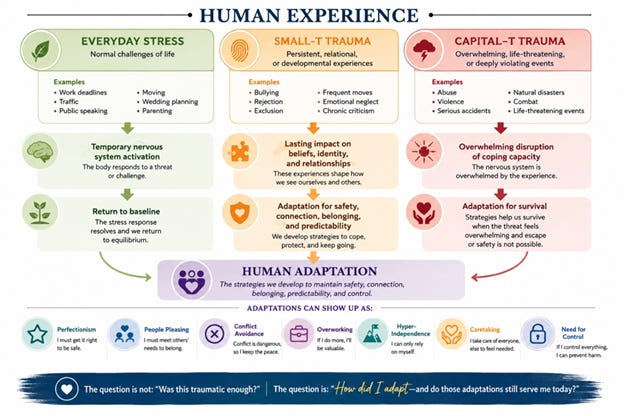
Human beings are remarkably adaptive. In fact, adaptation may be one of our greatest strengths. When we encounter a challenge, uncertainty, rejection, instability, or threat, our brains and bodies do not simply give up. They look for solutions. They search for ways to preserve safety, connection, predictability, and belonging.
Human beings are not unique in this regard. Adaptation is one of the most fundamental characteristics of life itself.
One of my favorite examples comes from biology. For generations, populations in parts of Africa experienced high rates of malaria. Individuals carrying a single sickle cell gene had increased protection against the disease. What might otherwise seem like a disadvantage became a life-saving adaptation within a specific environment.
The challenge is that adaptations are always shaped by context. What helps us survive one environment may not help us thrive in another. An adaptation that is protective under one set of conditions can become limiting under different circumstances.
The same is true psychologically. Many of the patterns we carry into adulthood began as intelligent responses to difficult circumstances.
The child who learns that achievement earns approval may become the high-performing executive who struggles to rest.
The child who learns that conflict is dangerous may become the leader who avoids difficult conversations.
The child who feels responsible for a parent’s emotions may become the manager who feels responsible for everyone’s well-being.
The child who learns that mistakes lead to criticism may become the employee who avoids risk, feedback, and innovation.
These patterns are not evidence that something is wrong with us. They are evidence that, at some point, we adapted. Maybe it wasn’t something we would consider traumatic. Maybe it was simply something difficult, painful, or uncertain. At one point in time, these strategies worked. They helped us maintain connection, avoid rejection, reduce uncertainty, or increase our sense of control.
They helped us survive.
The challenge is that the environments that shaped us are often different from the environments we occupy today. The adaptations that once protected us can become the very things that limit us. What once helped us stay safe may make it difficult to trust. What once helped us gain approval may make it difficult to rest. What once helped us avoid conflict may make it difficult to have the conversations that leadership requires.
The goal, then, is not to eliminate our adaptations or judge ourselves for having them. The goal is to understand them and to recognize the wisdom they once contained while becoming curious about whether they still serve us today.
The Rise of Trauma-Informed Care
When I first entered the trauma field, the language of trauma-informed care was still relatively new. Most of us working in child-serving systems were focused on a practical challenge: how do we translate what we know about trauma into something usable for the professionals who interact with survivors every day?
Child welfare workers.
Advocates.
Teachers.
Attorneys.
Juvenile justice professionals.
Many of these individuals were not therapists, nor were they expected to become trauma specialists. Yet their interactions mattered. The receptionist greeting a frightened parent. The teacher responding to a disruptive child. The caseworker conducting a home visit. These moments could either increase distress or support healing.
Trauma-informed care emerged as a framework for understanding those interactions. At its core, trauma-informed care asks organizations to recognize the widespread impact of trauma and integrate that understanding into policies, practices, and relationships. Rather than focusing solely on treatment, it encourages systems to create environments characterized by safety, trustworthiness, collaboration, empowerment, and cultural responsiveness.
It was a profound shift. Instead of asking, “How do we fix people?“ we began asking, “How do we create environments where healing becomes more possible?“
I was fortunate to be part of that movement early in its development. I helped support trauma-informed implementation efforts in child welfare systems, trained professionals across disciplines, and spent years translating trauma science into practical strategies. For a long time, I believed that if we could simply help organizations become more trauma-informed, many of the challenges we faced would begin to resolve themselves. What I eventually discovered was more complicated.
When Trauma Language Became Mainstream
Over the last decade, trauma moved from specialized professional conversations into popular culture. In many ways, this was validating. Work that had lived in the margins for years was finally receiving the attention it deserved. More people began to understand that adversity affects development, relationships, physical health, and emotional well-being.
But as trauma language became more widespread, something else began to happen. The term started to lose precision. Increasingly, I heard the phrase “that’s not trauma-informed” used as a strategy to end conversations, or to disagree with a decision that was made without providing detail or complexity. If something wasn’t trauma-informed, the conversation often stopped rather than deepened.
A policy someone disliked became “not trauma-informed.”
A difficult decision became “not trauma-informed.”
Accountability became “not trauma-informed.”
Conflict became “not trauma-informed.”
At times, it felt as though trauma-informed care was becoming less of a framework for understanding people and more of a moral identity. If you were trauma-informed, you were good. If you weren’t, you were not. The complexity disappeared. The nuance disappeared. And perhaps most concerning, curiosity disappeared.
This created a challenge. Because leadership is fundamentally a practice of navigating complexity. Leaders are required to make difficult decisions. They must balance competing needs and priorities at various scales. They sometimes disappoint people. They occasionally get things wrong. No amount of trauma knowledge removes those realities. In fact, many of the most important leadership moments occur precisely when there is no perfect answer available.
The Pandemic and the Leadership Gap
For me, the turning point came during the COVID-19 pandemic. At the time, I was the Clinical Director at a large children’s advocacy center. Like many leaders, I found myself responsible for supporting a workforce that was simultaneously caring for vulnerable individuals while navigating its own uncertainty, fear, grief, and exhaustion. Trauma became less about the families we served and more about what our staff was experiencing. What struck me most about the pandemic is how it became the perfect laboratory to observe our stress and trauma responses unfolding in real time.
The language of trauma was everywhere. And yet, despite all of our trauma knowledge, something wasn’t working. Organizations that had spent years becoming trauma-informed were still struggling with burnout, conflict, disengagement, turnover, and mistrust. Leaders were overwhelmed. Staff were overwhelmed. Everyone was carrying more than they could sustain.
It became increasingly clear to me that we had become very skilled at understanding the trauma histories of the people we served. We were much less skilled at understanding how our own life experiences, whether they were “Capital-T” traumas, “small-t” traumas, or simply years of accumulated stress, shaped how leaders and teams functioned under sustained pressure and chronic overwhelm.
As a leader, I found myself searching for a way to make sense of it all while still supporting my team. Like many organizations during that time, we experienced changes within our senior leadership structure and, almost overnight, I became the Executive Director.
When I think back on that period, I’m honestly surprised I survived it. I was operating on high alert almost constantly, trying to navigate the demands of a new leadership role while managing my own responses to a global pandemic. And if I’m being honest, I often felt alone. Not because I lacked support. I was surrounded by talented, compassionate leaders. But they were navigating their own responses to the same uncertainty.
In a sense, we became one large, activated nervous system.
When I reflect on that time, there is much that I’m proud of. There is also much that I would do differently. My own “small-t” traumas were being activated daily. The adaptations that had served me well for years—work harder, be helpful, don’t make a fuss—were no longer serving me in the same way. What had once helped me succeed was contributing to my exhaustion. I was emotionally depleted, physically drained, and showing many of the signs of burnout.
That experience forced me to ask a different question. The question was no longer simply:
“What happened to the people we serve?”
The question became:
“What happens when entire systems are operating under chronic stress, uncertainty, and overwhelm?”
From Trauma-Informed Care to Trauma-Informed Leadership
As I explored that question, I found myself reconnecting with what trauma-informed care was originally trying to accomplish. At its best, trauma-informed care was never simply about trauma. It was about understanding human behavior within context. It encouraged us to move beyond judgment and toward curiosity. Rather than asking, What’s wrong with this person?, we learned to ask, What happened to them? and How might those experiences help us understand what we’re seeing today?
Those principles remain incredibly important. Over time, however, I came to believe that they apply just as much to leaders and teams as they do to the people we serve. The same curiosity that helps us understand a client’s behavior can help us understand conflict within a team. The same commitment to safety and trust that supports healing can help create healthier organizational cultures. The same recognition that adversity shapes behavior can help us make sense of how leaders respond to pressure, uncertainty, criticism, and change.
In that sense, trauma-informed leadership is not a departure from trauma-informed care. It is an extension of it.
The focus simply shifts. Instead of asking only how trauma affects the people we serve, we begin asking how life experiences—including trauma, chronic stress, disappointment, loss, rejection, uncertainty, and change—shape the people doing the serving. Instead of focusing exclusively on healing trauma, we focus on creating conditions that help people function well together. And instead of asking whether a behavior is right or wrong, we become curious about the adaptations that may be influencing it.
The longer I did this work, the less interested I became in trauma as a category and the more interested I became in adaptation as a process. When I looked across organizations, I noticed that many of the behaviors creating challenges were not random. They were deeply human attempts to maintain safety, connection, belonging, predictability, or control.
The leader who micromanaged.
The supervisor who avoided difficult conversations.
The team member who became defensive when receiving feedback.
The executive who felt personally responsible for everyone’s well-being.
Each of these behaviors made sense when viewed through the lens of adaptation. At some point, the behavior solved a problem. At some point, it created safety. protected a relationship, preserved belonging, reduced uncertainty, or increased predictability. The behavior wasn’t irrational. It was adaptive. And once I began viewing organizations through that lens, everything started to look different.
The conversation shifted from blame to understanding.
The focus shifted from fixing people to creating healthier conditions.
And leadership itself became less about controlling outcomes and more about understanding what people need in order to think clearly, stay connected, and do meaningful work under pressure.
That realization became the foundation of my trauma-informed leadership work. Today, I see trauma-informed leadership less as a framework for understanding trauma and more as a framework for understanding how human beings adapt to their environments in search of safety, connection, belonging, and control. It offers a way of recognizing that all of us carry histories that shape how we engage with the world. A way of helping people become more aware of the patterns that influence their choices. And a way of creating environments where people can remain connected, thoughtful, and effective—even in systems that generate stress, uncertainty, and overwhelm.
Because effective, human-centered leadership is not about eliminating adversity or maximizing productivity at all costs. It is about creating the conditions that help people thrive despite it. And increasingly, I believe that begins with understanding the strategies that helped us survive.